01
Not knowing what to search for
Without specialist product terms or categories, finding the right assistive device can stop before it starts.
You do not need to know the name of an assistive device. AblePick AI understands everyday challenges and photos, then explains relevant tools, practical use, and alternatives in plain language.
AblePick AI is an information and exploration aid, not a medical diagnostic service. It directs high-risk situations to qualified professionals first.
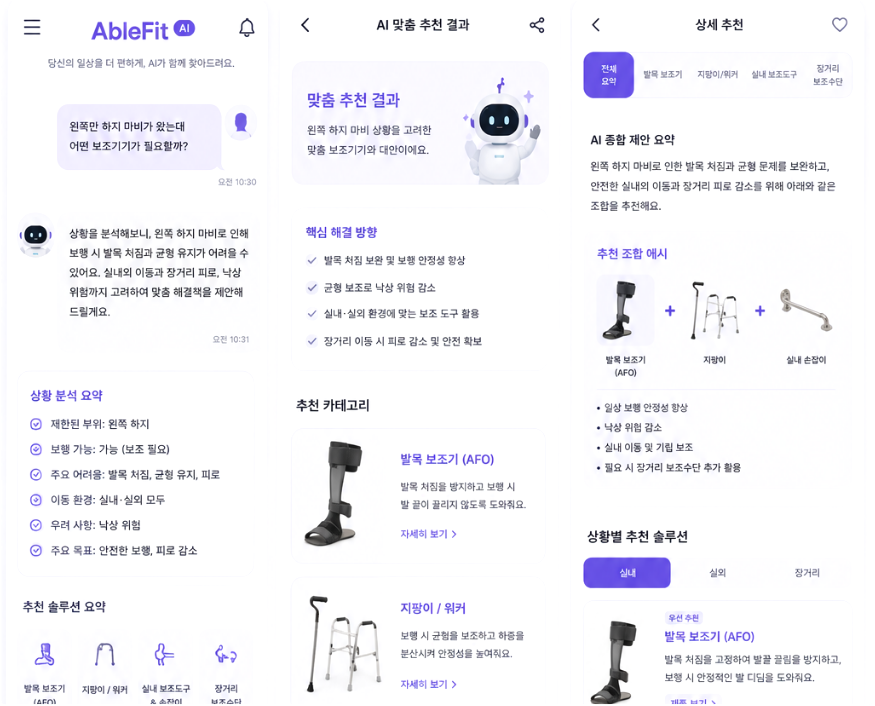
A combination that considers both gait stability and fatigue is prioritized.
The Problem
People with disabilities and their families explain what is difficult before they know a product name. Existing search experiences rarely translate that language into a practical solution.
Without specialist product terms or categories, finding the right assistive device can stop before it starts.
Product lists exist, but it is hard to judge whether they fit a person’s body, setting, and goals.
Fit, placement, and posture changes are hard to see, making decisions more uncertain.
After a recommendation, people still need to search again for advice, support information, alterations, or providers.
How It Works
Instead of choosing a disability category first, simply describe what is difficult now and what you want to do.
Share challenges, setting, and goals in everyday language, with photos if useful.
Interpret mobility limits, daily setting, fatigue, and safety together.
Suggest a combination of assistive devices, use tips, environmental changes, and alternatives.
Check a photo simulation and move to advice or support information.
Product Preview
These AblePick AI prototype screens are from our presentation. Use the tabs to explore representative features.
Rather than naming a single product, we consider body condition, mobility environment, fatigue, and fall risk to explain device combinations and context of use.
Why AblePick
We add an analysis and recommendation layer that reads a person’s context on top of existing information resources.
Everyday Scenarios
From mobility and posture to dressing, home safety, and computer access, the starting point is a person’s real life.
“When I sit for a long time, my torso leans to one side and I get exhausted.”
Possible direction: Consider a power wheelchair with tilt/recline, lateral support pads, and posture-support options.
“Putting these pants on and taking them off while seated is very difficult.”
Possible direction: Visualize magnetic or Velcro closures, elastic waists, side openings, and adaptive clothing alternatives.
“I worry about slipping when I move around the bathroom.”
Possible direction: Suggest priority placement for grab bars, shower chairs, and non-slip equipment.
“Can I use a computer if moving my hands is difficult?”
Possible direction: Explore purpose-specific combinations such as voice input, eye tracking, switch access, and arm supports.
Responsible AI
We do not present recommendations as definitive diagnoses. We explain evidence and limitations, and handle sensitive disability information and body images only for the stated purpose.
Build Access Together
If you are interested in AblePick AI beta testing, collaboration with assistive-technology or rehabilitation organizations, or partnerships, we would love to hear from you.